
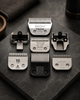
How to Choose the Right Dog Clipper Blade or Attachment Comb
, by Martin Forshaw, 9 min reading time
, by Martin Forshaw, 9 min reading time
Choosing the correct clipper blade or attachment comb can make the difference between a smooth, comfortable groom and a frustrating, uneven result.
The right choice depends on more than the finished length you want. You also need to consider the dog’s coat type and condition, the area being clipped and the blade system fitted to your clipper.
This guide explains the most common dog clipper blade sizes, when to use an attachment comb and how to choose the safest, most practical option for the job.
A clipper blade cuts the coat directly. It is normally the best choice when you need a short, precise finish or when working on areas such as the feet, face or hygiene areas.
An attachment comb fits over a suitable clipper blade and leaves more coat behind. Combs are commonly used for longer body trims and soft, fluffy finishes where you want to retain more length.
As a simple rule:
Choose a blade for close clipping, detailed work and shorter practical trims.
Choose an attachment comb when the coat is in good condition and you want to leave it longer.
Choose scissors for lengths beyond the range of your attachment combs or for shaping and finishing.
One of the most confusing things about clipper blades is that a higher blade number usually produces a shorter cut. For example, a No.30 blade cuts much closer than a No.4F blade.
Blade numbers are not a linear measurement, so it is always better to check the stated cutting length in millimetres rather than relying on the number alone.
The following table covers some of the most commonly used A5-style detachable grooming blades:
| Blade size | Approximate coat left | Common uses |
|---|---|---|
| No.40 | 0.25mm | Extremely close specialist or veterinary preparation |
| No.30 | 0.5mm | Very close work and underneath compatible attachment combs |
| No.15 | 1.2mm | Detailed clipping, feet and hygiene areas |
| No.10 | 1.5mm | Face, feet, hygiene areas and short practical clipping |
| No.9 | 2mm | Short body work where a little more length than a No.10 is wanted |
| No.8.5 | 2.8mm | Short, neat body finish |
| No.7F/7FC | 3.2mm | Short full-body clips and practical trims |
| No.5F/5FC | 6.3mm | A slightly longer, smooth body finish |
| No.4F/4FC | 9.5mm | Medium-length body trims |
| No.3F/3FC | 13mm | One of the longest finishes available from a detachable blade |
These lengths are approximate. The finished result can vary slightly between manufacturers, coat types and clipping direction.
These common sizes are available across our Andis UltraEdge dog grooming blades and Andis CeramicEdge blades. Check that your clipper uses a compatible A5-style fitting before ordering.
Clipping against the natural direction of coat growth will normally produce a shorter finish than clipping with the coat. Reverse clipping should therefore be approached carefully, particularly on sensitive skin.
Blades marked F, FC or Finish Cut have evenly spaced teeth designed to leave a smooth, finished appearance. These are generally the best option for normal body clipping and finishing work.
Skip-tooth blades have wider gaps between the teeth. They allow bulky or coarse coat to feed into the blade more easily and can be useful for rough clipping or removing coat before the final finish.
However, the wider tooth spacing also means that skip-tooth blades require greater care around loose skin, skin folds and delicate areas. They are primarily professional tools and should not be treated as a safer or easier way to remove severe matting.
For most customers looking for a straightforward body clip, a finish-cut blade is usually the more suitable choice.
Attachment combs are ideal when you want to retain more coat than a blade alone would leave.
Common stainless-steel attachment comb lengths include:
| Comb size | Approximate coat left |
|---|---|
| No.1 | 3mm |
| No.2 | 6mm |
| No.3 | 10mm |
| No.4 | 13mm |
| No.5 | 16mm |
| No.6 | 19mm |
| No.7 | 22mm |
| No.8 | 25mm |
Some brands use different numbering or colour systems, so always check the millimetre measurement printed on the comb.
Attachment combs work best on a coat that is:
Clean and completely dry
Thoroughly brushed
Free from knots and matting
Combable from the skin to the end of the hair
A useful test is to run a metal grooming comb through the coat before clipping. If the metal comb cannot pass through easily, the clipper attachment comb is unlikely to do so either.
Trying to force an attachment comb through tangled or tightly matted coat can pull painfully on the skin and produce a very uneven finish. In this situation, a shorter blade may be necessary, although severe matting should be assessed by an experienced groomer.
This depends on the particular attachment comb set.
Many A5-style stainless-steel combs are designed to fit over No.10, No.15 or No.30 detachable blades. Some sets will also fit No.8.5 or No.9 blades. A No.30 is commonly used by professional groomers because its short teeth allow the attachment comb to sit close to the blade, but it should only be used when the comb manufacturer confirms compatibility.
Combs made for a 5-in-1 adjustable blade are a different size and fitting. They are commonly used with clippers such as the Wahl Bravura, Arco and similar adjustable-blade models.
Do not assume that an A5 attachment comb will fit a 5-in-1 blade, or vice versa. Always match the comb set to both the blade and the clipper. Browse our Andis attachment combs for compatible Andis options.
These are useful starting points rather than fixed rules:
| Grooming job | Suggested starting point |
|---|---|
| Face, feet and hygiene areas | No.10 or an appropriate adjustable-blade setting |
| Very short, practical body clip | No.7F |
| Short but less severe body finish | No.5F |
| Medium-length body trim | No.4F |
| Longer blade finish | No.3F |
| Soft or fluffy finish from 10–25mm | Suitable attachment comb |
| Coat longer than 25mm | Attachment comb where available, followed by scissor finishing |
The dog’s coat and skin must always take priority over a requested number. The same blade can look very different on a fine-coated dog, a dense curly coat and a coarse coat.
An attachment comb cannot safely pass underneath tight matting. If the mat sits close to the skin, choosing a longer comb will not preserve the coat—it will simply catch on the mat.
The correct blade is the longest blade that can pass safely beneath the mat without pulling the skin into the teeth. This decision requires care because matting can hide sores, irritation and extremely thin skin.
Do not force a blade beneath a mat or try to cut tight mats out with scissors. Severe or skin-tight matting is best handled by a qualified professional groomer.
Double-coated breeds should not automatically be clipped simply because the weather is warm or the coat is shedding.
In many cases, thorough brushing, de-shedding and removal of compacted undercoat will be more appropriate than taking the coat short. Clipping may still be recommended for medical, welfare or individual grooming reasons, but it is sensible to ask a professional groomer before shaving a double coat for the first time.
Before buying any blade, identify the blade system used by your clipper.
The most common systems include:
A5-style detachable blades: Used by many professional Andis clippers, as well as Oster, Wahl and Heiniger models. Blades can be removed and replaced with different cutting lengths.
5-in-1 adjustable blades: Found on clippers such as the Wahl Bravura and Arco. One blade provides several close cutting settings.
Proprietary blade systems: Clippers such as the Aesculap Favorita use their own blade fitting and require compatible blades.
Adjustable taper blades: Common on lighter-duty pet and hair clippers. These usually use model-specific attachment combs.
A blade that looks similar may still have a different fitting. If you are unsure, check the clipper’s model number before ordering.
Even the best blade will struggle on a dirty, damp or tangled coat. For the smoothest result:
Brush out loose hair and knots.
Wash the coat where appropriate.
Dry it thoroughly, lifting and straightening the coat as you work.
Check that a metal comb passes through to the skin.
Choose the cutting length only after assessing the prepared coat.
Good preparation allows the blade or comb to move through the coat more easily and helps produce an even finish.
Clipper blades generate heat through friction. Check the blade temperature regularly and change to a cool blade before it becomes uncomfortable against the skin.
Keep the flat face of the blade against the dog rather than digging the teeth into the coat. Take extra care around armpits, ears, lips, tuck-ups, loose skin and other folded areas.
Blades should be:
Brushed free of trapped hair
Cleaned and disinfected appropriately
Oiled according to the manufacturer’s instructions
Checked regularly for damaged teeth
Stored dry and protected from knocks
A blade that drags, snags or leaves tramlines may be dirty, incorrectly fitted, blunt or in need of professional attention.
For a complete cleaning, oiling and storage routine, read our clipper blade care guide. For regular lubrication, choose a suitable fine oil such as Andis clipper oil or our Diamond Edge clipper oil.
The clipper model, desired cutting length and coat type are normally enough to narrow down the right choice.
If you are uncertain, contact Diamond Edge with the make and model of your clipper, the breed or coat type you are working with and the approximate length you want to leave. We can help you find a compatible blade or attachment comb before you order.